.svg)

Decolonizing Marketing Facilitator Spotlight: Getting to know Sahibzada Mayed


Author: Gary Spinks
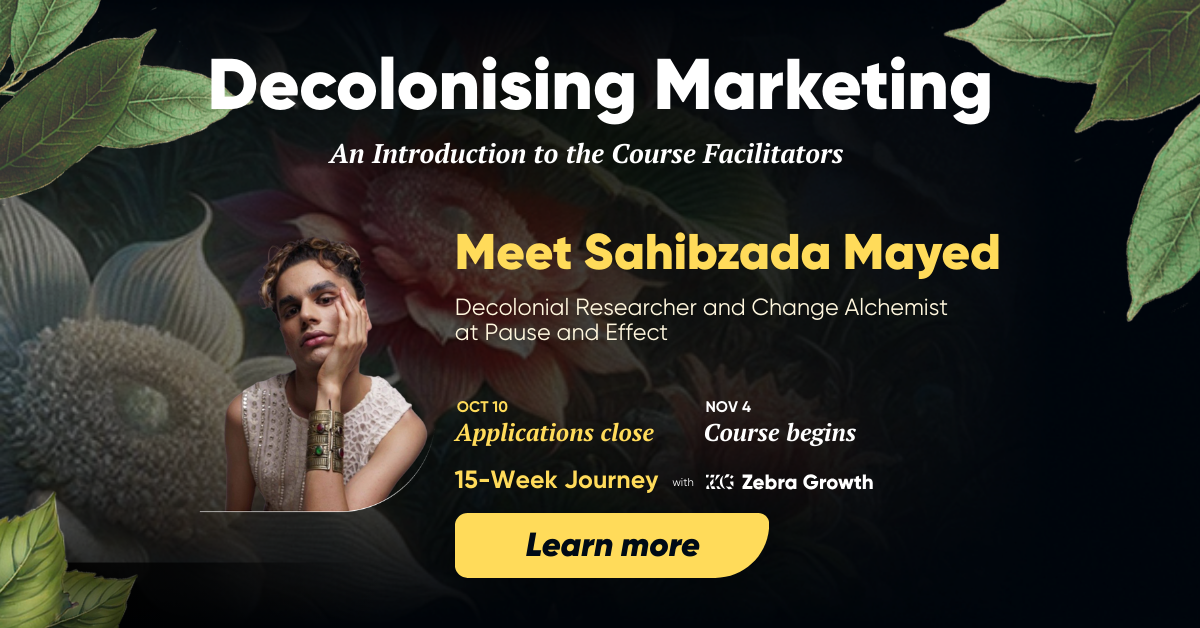
If people are asking “How do we undo colonialism?”, they’re asking the wrong question.
Better to ask:
- What are the ways in which I am attached to colonial narratives and systems”
- What are the ways in which I benefit from them?
- What are the ways in which I am harmed by them?
This is the view of Sahibzada Mayed, Decolonial Researcher at Pause and Effect, talking to Zebra Growth as part of our Spotlight series on guest facilitators for our forthcoming Decolonising Marketing course.
Mayed – also a self-labelled Feisty Fashionista, Eclectic Experience Designer and Sassy Storyteller – has deep-rooted lived experience of colonialism.
They grew up in South Asia and Pakistan, and spent six years in the USA (between 2019 and 2025) before moving to Southeast Asia. A family background strongly connected with the land, through farming and agriculture, contrasting sharply with the culture shock, “disintegration” and “violent histories” of North America.
Mayed says: “I can’t undo colonialism. I come from a particular history that has over 300 years, very recently, of British colonialism. I can’t undo that. How do I go back and undo the displacement, the borders, the partitioning, the cultural loss, the language erasure – all of those things? You can’t undo that.”
For Mayed, colonialism is not an historical event or the past. It is a system alive and emergent, and “actively in front of us.”
For them, decolonisation work cannot be separated into the personal, professional and political. Work, life, politics, cultural practices and relationships are all “intertwined” and “woven together.”
During our upcoming course, Mayed will explore reclaiming narratives, how marketing can be a tool for world making, and how we can imagine research as a ‘relationship’ rather than an extractive and controlling process.
As a “hardcore” STEM child, Mayed immersed themselves in natural sciences, engineering and technology. They have wrestled with “a lot of questions” around the ethics of technology and observed “significant public backlash” towards ‘AI First’ policies.
Mayed says: “People are craving authenticity at this time, and people are craving connection. Because those are things that in recent years have really just diminished and, quite frankly, become more detached, sterile. It’s really hard to create authentic relationships now.”
For Mayed, part of the approach to decolonizing marketing is the power of authentic storytelling through the themes of reclamation and remembrance. A clarion call for a reimagining of marketing – exploring how we tell stories, who gets to tell them, on whose terms and how stories are told.
Their aim is to help people “reclaim their own narratives. Reconnect with their own histories, their own cultural practices”… and be open to doing that in a collaborative way.
Mayed says: “When you talk about decolonizing marketing you’re actually decolonizing yourself… You’re truly decolonizing marketing when you also learn how to decolonize your life.”